
Bowel health
About the bowel
The bowel, or intestine, is the muscular tube of the digestive system that processes food, absorbs nutrients and minerals and forms waste.
It consists of the small bowel, which absorbs most nutrients and the large bowel (colon, rectum and anus), which absorbs water and forms stool. Its contents are moved along by wave-like muscle contractions (peristalsis) and it eventually eliminates waste products from the body as stool or poo.
Stool consistency can vary depending on how long it has stayed in the body. Ideally this is a soft, smooth shape, which is easy to pass.
What is normal?
It is normal to open our bowels or have a poo anywhere between 3 times per day to 3 times per week. Stools should be soft and easy to pass.
Everyone’s bowel function is individual and can vary depending on diet, fluid, lifestyle and age.
It is normal to:
- have an awareness of the need to open our bowels
- hold on, to go at an appropriate time and place
- open bowels completely, without straining
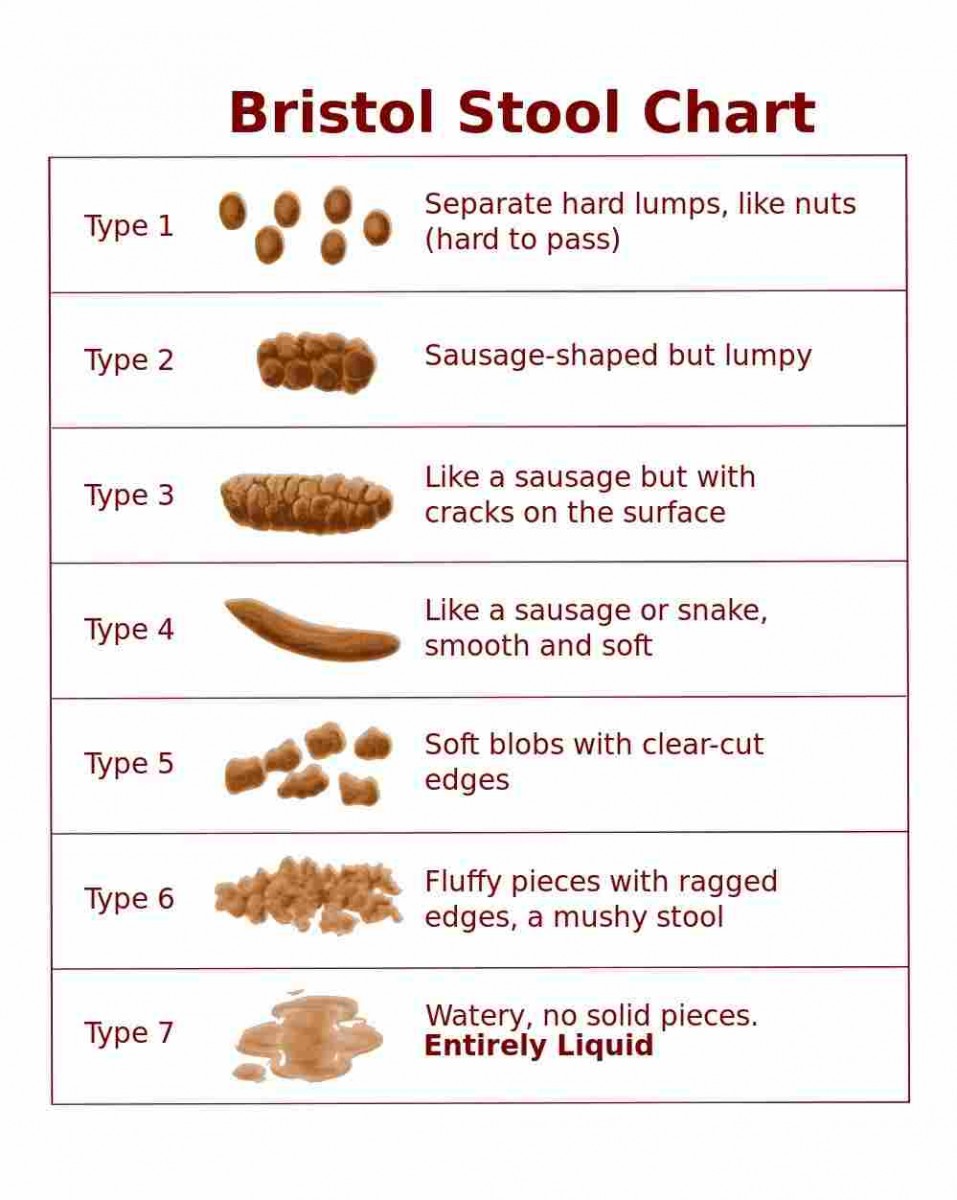
The Bristol Stool Chart is a tool used by health care professionals to assess your stool and look for constipation. It is important to know what is normal for you, and your bowel.
What can pelvic health physiotherapy help with?
- Difficulty passing a poo, which is hard, dry and/or lumpy
- Having a poo less than 3 times per week
- Feeling as if the poo is getting stuck or obstructed
- A sudden, intense and uncontrollable need to have a poo
- Having to rush to get to the toilet to have a poo
- Poo leaking out without being able to stop it
- Feeling like you need to poo, but not being able to get to the toilet in time
- Not being able to get fully clean after having a poo
- Seeing streaks or stains of poo in your underwear
- Difficulty holding in wind
Bowel health management
Good bowel function is really important for feeling well. The following tips will help to keep your bowels healthy:
- Drink 1.5 to 2 litres of fluid per day
- Eat regular meals through the day
- Include in your diet 15 to 30g fibre per day for adults, as part of a balanced diet
- Exercise and movement can help to stimulate your bowel
- Sleep and rest at a similar time each day allows the digestive system to rest
- Reducing stress - if you are feeling particularly stressed or anxious, try and factor in a daily time for relaxation or doing something enjoyable
- Empty your bowel when you get the urge as this is when the stool will be at its softest
- Consider any medications you are taking that could be impacting your bowels
What you can do to help
- Sit with your feet apart and raised on a stool, rest your arms comfortably on your knees
- Keep your stomach relaxed
- Focus on calm and even breathing
- Give your body time to allow the pelvic floor muscles to relax
- Do not strain
- Do not hover over the toilet
Some women may need to support the perineum (the area between the vagina and back passage) when emptying bowels. You can do this externally, by applying pressure to the space between the vagina and back passage. Or you can do this internally, using a finger or thumb to apply gentle pressure through the vagina towards the back wall. This can help ensure the bowel is emptied fully and effectively.
This technique can help to improve control of faecal urgency. In a safe environment, such as at home, when needing to empty your bowels, practice holding on for a few extra seconds by engaging your pelvic floor muscles. Over time, you will be able to gradually increase the amount of time you are able to hold.
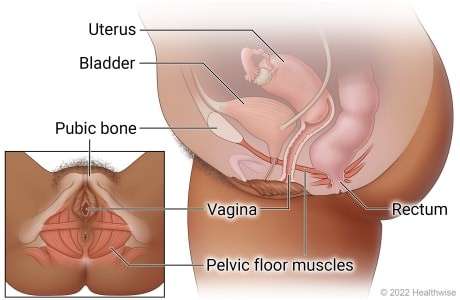
The pelvic floor muscles form a hammock underneath your pelvis to provide support to your pelvic organs. These muscles are affected by hormonal changes and may be weakened as a result of childbirth, pelvic surgery, persistent heavy straining due to constipation, a chronic cough, repetitive lifting and from being overweight.
For your bowels to work well, your pelvic floor needs to relax to help you empty your bowel and tighten when you need control to hold on when reaching the toilet. It is important to have good coordination between these actions to help prevent constipation, straining and discomfort.
A pelvic floor contraction is performed by closing and drawing up your back and your front passages. Imagine you are trying to stop yourself passing wind and at the same time trying to stop the flow of urine. It should feel a sensation of tighten and lift.
You can do this in all positions starting with lying and sitting and progressing over time to standing.
Find pelvic floor exercises for women
Find pelvic floor exercises for men
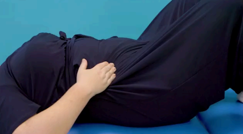
Abdominal massage is a useful technique to help with constipation and regulate normal bowel movements. In doing massage, peristalsis is stimulated – this is the bowel’s natural squeezing and processing that helps things shift along. When there is constipation or pain, this can be much slower.
It is easiest to do abdominal massage in a lying position to start with, as the abdominal muscles are softer. Some people find abdominal massage in sitting can also be beneficial. It can also be a soothing technique when there is bloating or lower abdominal pain as part of a chronic pain condition.
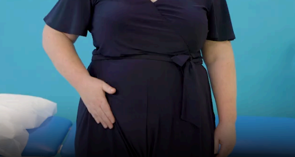
When looking at the evidence to support exactly what to do, the general principles are to start with a stroking technique, move on to kneading and then finish with stroking. The time can be variable, and it is worth exploring what works for you. Some people find 5 minutes is enough and others find it is useful to do at least 15 minutes.
Always start at the right-hand side of your body and work up from the hip bone towards the the lower ribs. Then move across towards the tummy button and over to the hip bone on the left side. Finally, down towards the left groin. This is the path of the colon - working up the ascending colon on the right-hand side, along the transverse colon and down the descending colon on the left.
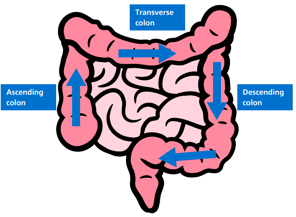 Start with a stroking technique; this can be gentle or firm and should be slow. Use your
fingers or the heel of your hand, working along the areas continuously and notice any areas which feel tender or firm. Then move on to a kneading technique. These are circles, which can be clockwise or anti-clockwise, and small or large. Repeat in the same direction as above. Then finish with repeating the stroking technique.
Explore speed, pressure, large or small movements and timings.
Need more help?
Consider self referring using the link below:
If you have a new injury or problem, please look at the self help information in our advice pages. We will often complete the same exercises and share information in clinic appointments.
If you still need some more help you can self refer into our service. Please note that the NHS is currently experiencing longer than normal waits, for more information visit our waiting times page.